A Non-Profit Project devoted to the Baroque Age Reviews, Articles, Historical Insights, Interviews and the greatest Harpsichord Musical Archive of the World!
JOHN CHRISTOPHER SMITH (Ansbach 1712 - Bath 1795)
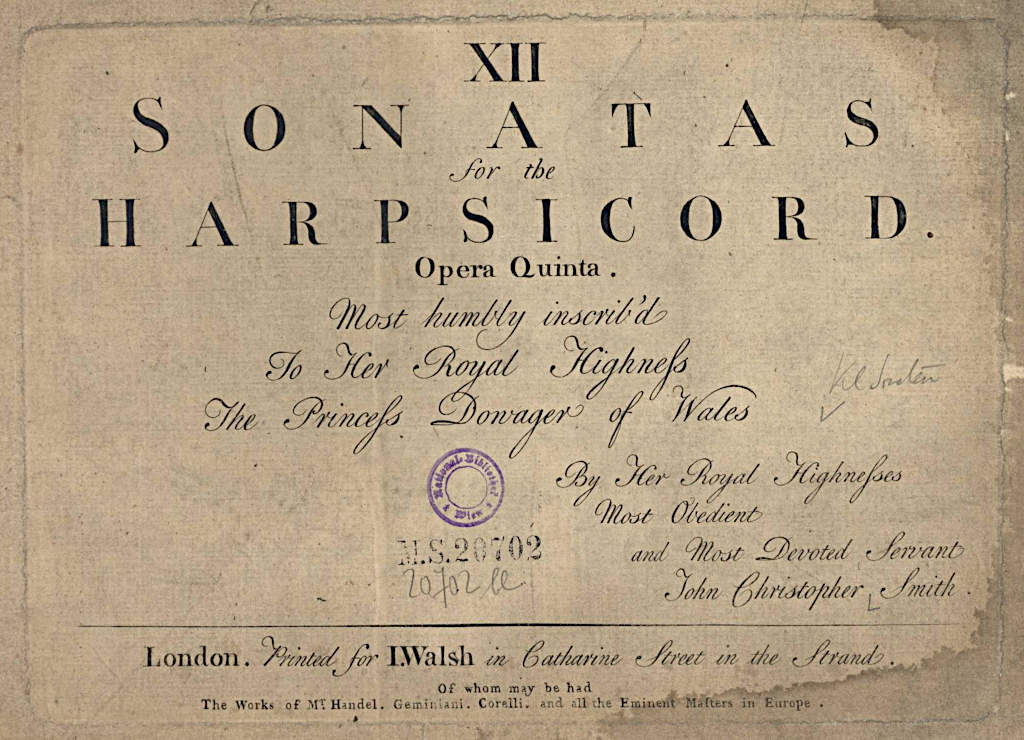
XII Sonatas for the Harpsichord, Op. 5
Most humbly inscrib'd / to Her Royal Highness The Pricess Dowager of Wales (London, 1765)
(*) Completed by Fernando De Luca: This recording is based on manuscript in Österreichische Nationalbibliothek, Ms.20702, which has last page missing (second part of Sonata XII last movement)
“Come un figlio d'arte”, introduzione in italiano Avviso!-) Questo podcast è stato sviluppato con la tecnologia IA generativa di Google, partendo dal nostro testo in lingua inglese visibile poco sotto. Il dialogo è stato validato, pur conservando pochi e isolati difetti di pronuncia che non ne pregiudicano l'ascolto.
s announced on an earlier page featuring the first four keyboard collections, Maestro Fernando De Luca has finally returned to the keyboard works of John Christopher Smith, completing the cycle with the Opera Quinta of 1765. This recording is likely to represent the first complete recording of this late collection, whose character is by then largely immersed in the galant style of the 1760s, while still preserving unmistakable references to certain stylistic conventions of the early decades of the century. Such traits are particularly evident in the sonatas in minor keys—most notably the Seventh Sonata in E minor—or in the Courante from the Sixth Sonata in D minor, which appears almost as a deliberate homage by Smith to his master, Handel.
John Christopher Smith “the younger” was born in Ansbach, in the German region of Franconia (today part of northern Bavaria), on 7 January 1712. His father, Johann Christoph Schmidt, became acquainted with Handel during his studies at the University of Halle, and from that moment onwards the relationship between the composer and the Schmidt family proved both fruitful and enduring. In 1716 Handel himself is said to have urged Schmidt to join him in London, where he embarked upon a career in the musical trade, involving the publication and sale of printed music (he opened the music shop The Sign of the Hand & Musick Book in the Haymarket), as well as serving as Handel’s personal copyist. By 1720–21, upon settling permanently in England, all members of the Schmidt family anglicised their names.
The music known and published today under the name of John Christopher Smith may with great probability be attributed exclusively to J. C. Smith junior, who around 1724–25 began his formal musical studies under Handel himself, a close friend of his father. In the years that followed, Smith refined his training under Johann Christoph Pepusch—another musician of German origin—and, above all, with Thomas Roseingrave, at Wigmore Street. From this point onwards, John Christopher’s growing involvement with London’s intellectual circles went hand in hand with his engagement with British musicians and with his deepening interest in Handelian music, of which he would absorb many defining features.
Documentary evidence confirms that by the mid-1730s Smith had his first opportunities to assist George Frideric Handel in the production of several theatrical works. During these same years, Smith published his first two keyboard collections of Suites (Op. 1 / 1732 and Op. 2 / 1735), stylistically very close to those of his teachers. Some twenty years later, at a time when musical taste had already undergone profound change, he issued two further collections entitled Lessons (Op. 3 / 1755 and Op. 4 / 1757). These coincide with the final years of Handel’s life, by then completely blind yet fully supported by his devoted assistant, John Christopher Smith the younger.
With the Opus 5 collection of 1765—consisting of twelve pieces now designated as Sonatas—Smith made his final contribution to the keyboard repertory. The publication was dedicated to his pupil, the dowager Princess of Wales, Augusta of Saxe-Gotha-Altenburg (1719–1772). For her, too, he later composed the music for the funeral service of 1772, before retiring to Bath, where he devoted himself exclusively to teaching girls of the music school. During the last few years of his life (1790-95), one may imagine the elderly composer becoming an essential destination for pilgrims among young musicians, men of letters and historians alike, eager to encounter the last surviving figure who had been the principal assistant and close friend of George Frideric Handel.
saladelcembalo.org, 2026 January 21
Issue 2026-02
Recorded in Borgo Ticino (Novara, IT) Dec 2025/Jan 2026, Sonatas 1-11: French harpsichord after Tibaut (1691) built by A. Di Maio (2018); Sonata 12: Italian harpsichord after Carlo Grimaldi (1697), built by F. P. Ciocca (2023). Audio eng. M. De Gregorio








 s announced on an