or the second time in the space of a decade, we are pleased to present a complete recording of Jean-Philippe Rameau's works for harpsichord.
For his first complete survey, recorded between 2014 and 2017, Fernando De Luca chose an excellent French double-manual harpsichord after the celebrated 1754 Blanchet instrument. This was arguably the most conventional and chronologically coherent choice, representing an instrument from a period only slightly later than Rameau's keyboard output, since virtually all of these compositions predate 1730, with only a handful of later self-transcriptions by the Dijon master.
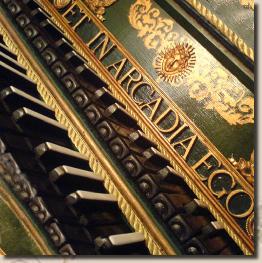
For the present recording, made in September and October 2023, De Luca elected instead to explore the sonorities of a French double-manual harpsichord after Tibaut, an instrument built more than half a century earlier than the Blanchet. From a historical perspective, this choice appears even more closely aligned with the chronology of Rameau's keyboard works. Between approximately 1700 and 1730, an instrument of this type would very likely have been among those available to a French harpsichordist for study, composition, and public performance.
The forty-seven works are presented in the order of their original publication. The collection opens with the Premier Livre de Pièces de Clavecin of 1706, issued during Rameau's brief stay in Paris. As previously observed, although the young Rameau was fifteen years younger than François Couperin, his keyboard writing at this stage appears stylistically more conservative than that of his celebrated Parisian contemporary.
The programme continues with Rameau's two principal and best-known harpsichord collections: the volume of 1724, containing the Suites in E minor/major and D minor/major; and the collection of 1727–28, which includes the monumental Suites in A minor/major and G major/minor.
The recording concludes with the five independent pieces. Four of these are Rameau's own keyboard transcriptions of movements from the Pièces de clavecin en concerts (1741), presented here alongside the corresponding chamber ensemble versions. The fifth piece, La Dauphine, generally dated to around 1747–50, may itself represent an extemporaneous transcription by the composer.
With the exception of these five later pieces—and a number of other isolated transcriptions—the three harpsichord books constitute Rameau's entire published output specifically intended for the instrument. After 1730 his interests shifted primarily towards the theatre and the publication of his theoretical writings.
Having settled permanently in Paris by 1722, Rameau entered the circle of the poet and dramatist Alexis Piron, whose collaborations provided him with numerous opportunities to compose incidental music. These activities ultimately paved the way for his first great operatic success, Hippolyte et Aricie (1733). It has been suggested that several pieces in the 1724 collection may derive from, or at least be connected with, stage music composed during these years, particularly L'Endriague (1723), whose score has unfortunately been lost.
Finally, it is worth recalling Kenneth Gilbert's observation concerning the first three variations of the Gavotte avec six doubles from the Suite in A minor (1727–28). Their close resemblance to the corresponding variations in Handel's Suite No. III in D minor (1720) may plausibly be interpreted as Rameau's tribute to the great Saxon harpsichordist and composer.
saladelcembalo.org
2026, June 28

Issue 2026-10
Recorded in Borgo Ticino (Novara, IT): Sept/Oct 2023
French harpsichord after Tibaut (1691) built by A. Di Maio (2018)
Audio eng. M. De Gregorio







 or the second time in the space of a decade, we are pleased to present a complete recording of Jean-Philippe Rameau's works for harpsichord.