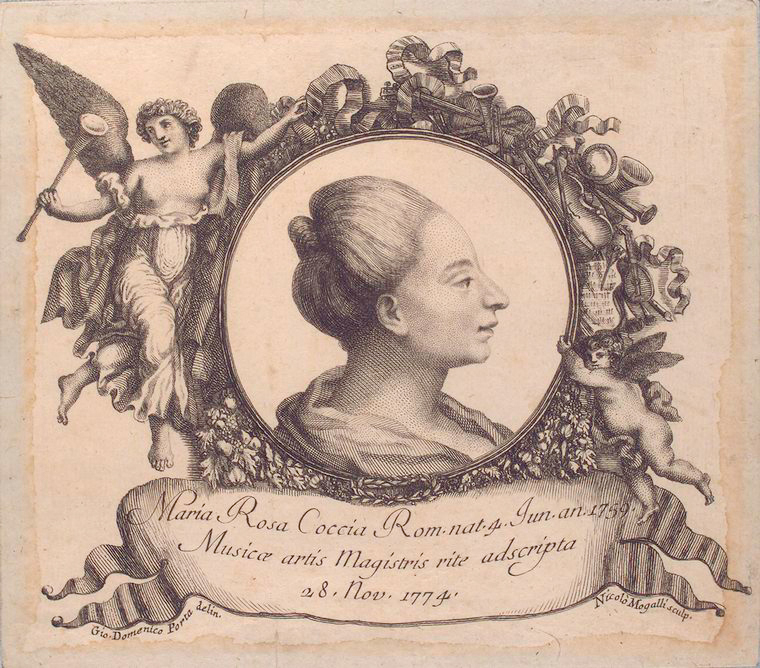
aria Rosa Coccia was born in Rome on 4 June 1759. Her exceptional musical aptitude manifested itself at an early age, particularly in keyboard performance and singing, leading her father to entrust her musical education to a professional instructor while she was still a child. Her progress proved remarkably rapid: contemporary accounts emphasise her ability to perform demanding keyboard repertory at sight, a skill that soon attracted the attention of Rome’s musical establishment.
Her earliest extant work is the set of Sei Sonate per clavicembalo (1772), dedicated to Charles Edward Stuart, symbolically acknowledged as “King of Great Britain”. Composed when Coccia was barely in her teens, these sonatas reveal a striking command of contemporary keyboard idioms and formal procedures. The dedication itself demonstrates an early awareness of the cultural and political significance that patronage and dedicatory practices continued to hold within eighteenth-century European musical life. The six sonatas, preserved today in manuscript form at the Library of the Accademia Nazionale di Santa Cecilia in Rome (MS A.194), are presented here in their entirety in a performance by Fernando De Luca. It is worth noting that the sixth and final sonata survives as a single-movement work, consisting solely of an Allegro. For the present recording, the performer has elected to supplement the surviving movement with a second and third movement of his own composition, conceived as a free completion of the sonata.
During the following years, Coccia pursued advanced studies in counterpoint and composition in Rome. In 1774 she achieved a milestone of considerable historical importance when, following a public examination that required the composition of a four-voice fugue, she was admitted to the Congregazione di Santa Cecilia. As the first woman to gain entry to the institution, she became the focus of intense discussion concerning female participation in the learned traditions of composition and ecclesiastical music, debates that resonated throughout Roman musical circles.
Equally noteworthy is her correspondence with Pietro Metastasio, although the relationship ultimately failed to secure the professional opportunities she had hoped for, particularly at the imperial court in Vienna and at the Russian court. Despite the remarkable promise of her early career and the formal recognition accorded to her by various institutions and academies, Coccia never succeeded in establishing a sustained professional position comparable to that enjoyed by her male contemporaries. Much of her compositional output has been lost, and the surviving documentary evidence relating to her later years remains sparse and discontinuous.
Coccia died in Rome in November 1833. Although only a portion of her oeuvre survives, her career occupies a singular place in the history of eighteenth-century Italian music. As one of the very few women to receive formal recognition as a composer within the institutional structures of her time, she stands as a pioneering figure whose surviving works offer valuable insight into Roman keyboard culture and compositional practice in the late eighteenth century.
saladelcembalo.org - 2026, june 14










 aria Rosa Coccia was born in Rome on 4 June 1759. Her exceptional musical aptitude manifested itself at an early age, particularly in keyboard performance and singing, leading her father to entrust her musical education to a professional instructor while she was still a child. Her progress proved remarkably rapid: contemporary accounts emphasise her ability to perform demanding keyboard repertory at sight, a skill that soon attracted the attention of Rome’s musical establishment.