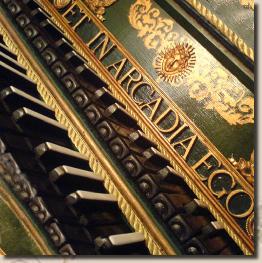
on questo progetto si conclude il percorso dedicato ai principali autori inglesi della stagione musicale successiva alla Restaurazione. Torniamo nuovamente su un repertorio che il clavicembalista Fernando De Luca aveva in larga parte inciso nel 2013 su un diverso strumento: una copia del cembalo tedesco di Christian Vater (1739) a singolo manuale. La presente registrazione propone invece una nuova lettura integrale delle Suite e dei brani sciolti attribuiti a William Croft, eseguiti su un cembalo di scuola italiana costruito da Carlo Grimaldi nel 1697, anch’esso a singolo manuale ma caratterizzato da un timbro più pieno e corposo rispetto al modello di tradizione tedesca.
William Croft nel contesto della scuola inglese
Tra i principali musicisti inglesi dell’età della Restaurazione, Croft può essere considerato l’ultimo autentico erede della tradizione che ebbe in John Blow e soprattutto in Henry Purcell i suoi protagonisti più rappresentativi. Dopo di lui, la scuola musicale britannica intraprese un rapido processo di trasformazione stilistica: lo stile nazionale si trovò progressivamente a convivere con gli influssi italiani, introdotti dapprima da George Frideric Handel e Domenico Scarlatti, e successivamente sviluppati da figure del tardo barocco inglese come Maurice Greene e da compositori del primo classicismo, tra cui Johann Christian Bach.
Formazione e modelli stilistici
Croft, quasi coetaneo di Antonio Vivaldi ma stilisticamente distante da quest’ultimo, ricevette la propria formazione musicale nel coro della Chapel Royal sotto la direzione di John Blow negli ultimi anni del XVII secolo. Gran parte della sua produzione cerimoniale rivela chiaramente il modello purcelliano: le strutture compositive e il linguaggio retorico derivano spesso dagli esempi di Purcell. Tuttavia il risultato appare, da un lato, meno impetuoso e ispirato; dall’altro, più levigato e formalmente elaborato.
La figura di Croft si colloca quindi in una posizione di transizione: un musicista intenzionato a preservare la tradizione britannica pur accogliendo progressivamente le innovazioni stilistiche provenienti dal continente, in particolare dall’Italia.
Un episodio emblematico riguarda il suo Te Deum in re maggiore, che il compositore rielaborò dopo aver ascoltato nella cattedrale di St Paul l’esecuzione del Utrecht Te Deum (HWV 278) di Handel nel 1713. L’episodio è significativo: proprio Handel, nei primi anni londinesi, aveva modellato la propria musica cerimoniale guardando con attenzione alla tradizione purcelliana.
La produzione tastieristica
Per avere un quadro completo della produzione tastieristica di Croft è stato necessario attendere l’edizione critica curata da Howard Ferguson e Christopher Hogwood nel 1982. Il corpus comprende diciannove Suites — tutte costruite sul modello di quelle di John Blow — oltre a pochi brani isolati (tra cui alcuni Aire, una Scotch Tune e una Chaconne in la minore).
A questi si aggiunge una particolare suite-concerto, nota come Trumpet Overture in re maggiore: si tratta di una trascrizione per tastiera derivata dalle musiche che Croft compose per l’Università di Oxford e che gli valsero il titolo di Dottore in Musica nel luglio del 1713.
La tradizione aneddotica racconta che lo stesso titolo fu successivamente offerto anche a Handel: dopo aver impressionato il pubblico di Oxford con il suo oratorio Athalia nel 1732, il compositore avrebbe tuttavia rifiutato platealmente l’onorificenza.
Struttura e caratteristiche delle Suites
Le suites di Croft presentano una struttura relativamente compatta: il numero dei movimenti varia da due a cinque e la durata complessiva rimane generalmente contenuta, in linea con le raccolte tastieristiche dei suoi maestri.
Un tratto peculiare della scrittura di Croft consiste però nell’impiego ricorrente di uno stesso materiale tematico distribuito tra diversi movimenti della suite. Lo stesso tema può infatti essere condiviso da Almand, Courant e Saraband, generando una sorta di sequenza di variazioni implicite che attraversa l’intero ciclo. La Suite XV in la maggiore rappresenta forse l’esempio più evidente di questo procedimento compositivo.
Uno studio ancora oggi rilevante su questo repertorio è quello di Peter Holman, A New Source of Restoration Keyboard Music (RMA Research Chronicle, XX, 1986-87), che propone una lettura approfondita delle fonti e della tradizione tastieristica inglese della Restaurazione.
Marco De Gregorio - saladelcembalo.org
23 marzo 2026
 his project concludes the cycle devoted to the principal English composers of the post-Restoration period. The repertoire revisits works that harpsichordist Fernando De Luca had already partly recorded in 2013 on a different instrument: a single-manual harpsichord modeled after the 1739 instrument by Christian Vater.
The present recording offers a complete new interpretation of the Suites and miscellaneous pieces attributed to William Croft, performed on a single-manual Italian-school harpsichord built by Carlo Grimaldi in 1697, whose sonority is fuller and more resonant than that of the German model.
William Croft within the English School
Among the major English musicians of the Restoration, Croft may be regarded as the last true heir of the tradition represented above all by John Blow and Henry Purcell. After him, British musical culture underwent a rapid stylistic transformation, increasingly shaped by Italian influences introduced first by George Frideric Handel and Domenico Scarlatti, and later by figures such as Maurice Greene and early Classical composers including Johann Christian Bach.
Training and Stylistic Models
Croft, a near contemporary of Antonio Vivaldi though stylistically distant from him, received his musical education in the choir of the Chapel Royal under the direction of John Blow during the final decade of the seventeenth century. Much of his ceremonial music clearly draws upon Purcellian models; yet the resulting style often appears less dramatic in inspiration, while at the same time more polished and structurally elaborate.
Croft thus emerges as a transitional figure: a composer seeking to preserve the English tradition while gradually assimilating stylistic innovations arriving from continental Europe, particularly from Italy.
An illustrative case concerns his Te Deum in D major, which Croft revised after hearing Handel’s Utrecht Te Deum (HWV 278) performed at St Paul’s Cathedral in 1713. The episode is notable, since Handel himself had initially shaped his ceremonial works in London under the strong influence of the Purcellian tradition.
Keyboard Works
A comprehensive overview of Croft’s keyboard output became possible only with the critical edition prepared by Howard Ferguson and Christopher Hogwood in 1982. The corpus includes nineteen suites modeled on those of John Blow, together with a small number of independent pieces, including several Airs, a Scotch Tune, and a Chaconne in A minor.
To these should be added the so-called Trumpet Overture in D major, a suite-concerto arrangement derived from music Croft composed for the University of Oxford, which earned him the degree of Doctor of Music in July 1713.
Structure and Characteristics of the Suites
Croft’s suites are generally concise, containing between two and five movements. Their overall proportions remain modest, in keeping with the keyboard collections of his teachers.
A distinctive compositional feature, however, lies in Croft’s frequent reuse of the same thematic material across multiple movements. A single theme may appear successively in the Almand, Courant, and Saraband, producing a sequence that functions almost as a set of variations distributed throughout the suite. The Suite XV in A major provides a particularly clear example of this technique.
A still valuable discussion of these sources is offered by Peter Holman in A New Source of Restoration Keyboard Music (RMA Research Chronicle, XX, 1986–87).
Marco De Gregorio - saladelcembalo.org
2026 March 23 (Translated thanks to the OpenAI service)
e projet conclut le cycle consacré aux principaux compositeurs anglais de la période postérieure à la Restauration. Le programme reprend un répertoire que le claveciniste Fernando De Luca avait déjà en grande partie enregistré en 2013 sur un autre instrument : une copie d’un clavecin à un seul clavier inspiré du modèle de 1739 de Christian Vater.
La présente réalisation propose une nouvelle interprétation intégrale des Suites et des pièces isolées attribuées à William Croft, exécutées sur un clavecin italien construit en 1697 par Carlo Grimaldi, également à un seul clavier mais doté d’une sonorité plus pleine que celle du modèle allemand.
William Croft dans l’école anglaise
Parmi les musiciens anglais de la Restauration, Croft peut être considéré comme le dernier véritable héritier de la tradition illustrée notamment par John Blow et surtout Henry Purcell. Après lui, la musique britannique connut une transformation rapide, marquée par l’influence croissante du style italien introduit d’abord par George Frideric Handel et Domenico Scarlatti, puis développé par des compositeurs tels que Maurice Greene et par des représentants du préclassicisme comme Johann Christian Bach.
Formation et modèles stylistiques
Presque contemporain de Antonio Vivaldi, bien que stylistiquement éloigné de lui, Croft reçut sa formation musicale dans le chœur de la Chapel Royal sous la direction de John Blow à la fin du XVIIᵉ siècle. Une grande partie de sa musique cérémonielle s’inspire clairement des modèles de Purcell ; toutefois le résultat apparaît souvent moins impétueux dans l’inspiration, mais plus lisse et plus élaboré sur le plan formel.
Croft représente ainsi une figure de transition : un compositeur soucieux de préserver la tradition britannique tout en intégrant progressivement les nouveautés stylistiques venues du continent, en particulier d’Italie.
L’œuvre pour clavier
La vision complète de la production pour clavier de Croft n’a été possible qu’avec l’édition critique publiée en 1982 par Howard Ferguson et Christopher Hogwood. Elle comprend dix-neuf suites — toutes inspirées du modèle de John Blow — ainsi que quelques pièces isolées (Airs, Scotch Tune et une Chaconne en la mineur).
On y ajoute la Trumpet Overture en ré majeur, une transcription pour clavier dérivée des musiques que Croft composa pour l’Université d’Oxford, lesquelles lui valurent le titre de Docteur en musique en juillet 1713.
Structure et particularités stylistiques
Les suites de Croft présentent un nombre de mouvements variant de deux à cinq et une durée généralement brève, conformément à la tradition de ses maîtres.
Une caractéristique remarquable réside toutefois dans l’utilisation d’un même matériau thématique partagé entre plusieurs mouvements. Un thème peut ainsi circuler entre Almand, Courant et Saraband, créant une sorte de cycle de variations réparties dans la suite. La Suite XV en la majeur constitue probablement l’exemple le plus clair de ce procédé.
Une étude toujours pertinente sur ce sujet est celle de Peter Holman, A New Source of Restoration Keyboard Music (RMA Research Chronicle, XX, 1986-87).
Marco De Gregorio - saladelcembalo.org
23 mars 2026 (traduction réalisée à l’aide des services d’OpenAI)










 on questo progetto si conclude il percorso dedicato ai principali autori inglesi della stagione musicale successiva alla Restaurazione. Torniamo nuovamente su un repertorio che il clavicembalista Fernando De Luca aveva in larga parte inciso nel 2013 su un diverso strumento: una copia del cembalo tedesco di Christian Vater (1739) a singolo manuale. La presente registrazione propone invece una nuova lettura integrale delle Suite e dei brani sciolti attribuiti a William Croft, eseguiti su un cembalo di scuola italiana costruito da Carlo Grimaldi nel 1697, anch’esso a singolo manuale ma caratterizzato da un timbro più pieno e corposo rispetto al modello di tradizione tedesca.
 his project concludes the cycle devoted to the principal English composers of the post-Restoration period. The repertoire revisits works that harpsichordist Fernando De Luca had already partly recorded in 2013 on a different instrument: a single-manual harpsichord modeled after the 1739 instrument by Christian Vater.